

If you’re a restaurant owner deciding which reservation software to use, OpenTable and Now Book It will probably have made your shortlist. Chances are you don’t have time to read software contracts line by line. But when choosing between Now Book It and OpenTable, the fine print is exactly where the real differences live.
Think per-cover fees, who “owns” the guest that just booked, and whether the AI on the other end of your phone line is included or is yet another subscription you’ll need to bolt on.
Here’s the side-by-side breakdown.
Now Book It vs OpenTable: Side-by-side comparison
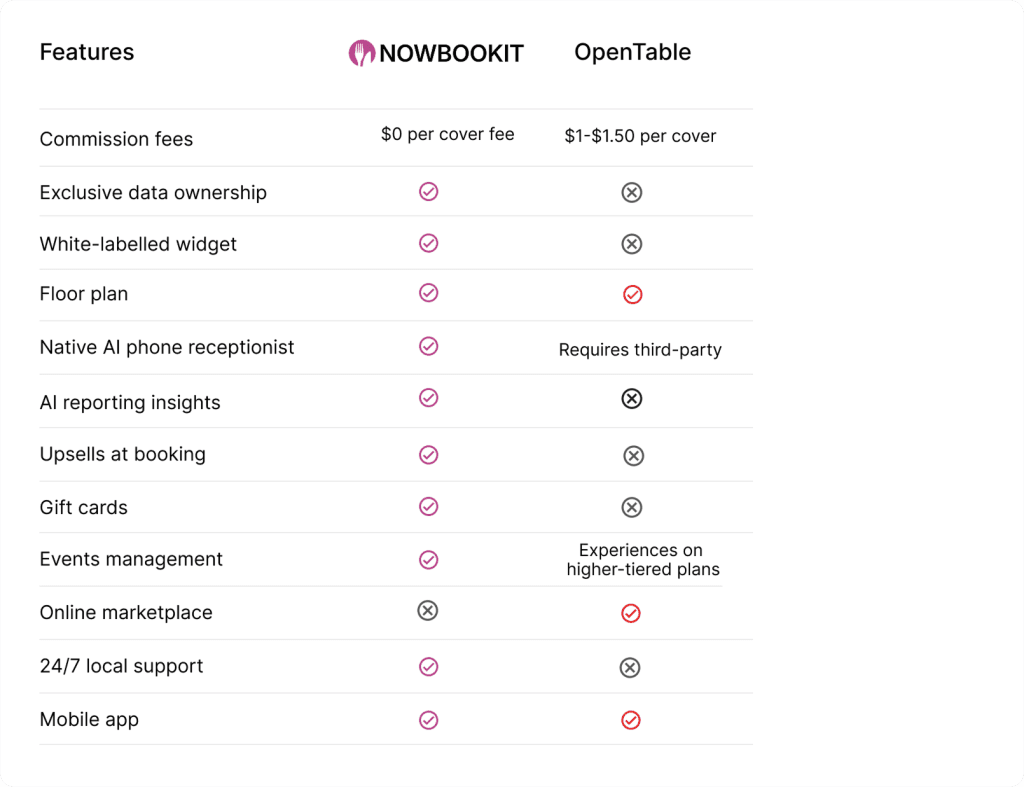
Note: This comparison reflects Now Book It’s assessment and is for general information. Product details and pricing change often — always verify current terms with each provider directly.
Pricing model
OpenTable runs on three published plans that runs from $149 to $499 per month, but that’s only half the bill. On top of the subscription, OpenTable charges $1 to $1.50 for every diner seated through its network, plus a 2% service fee on transactions like deposits and prepaid experiences as of early 2026. Website bookings are included free on Core and Pro, but on Basic they cost $0.25 a cover or a $49 flat monthly add-on. For a restaurant doing 1,500 network covers a month, that’s an additional $1,500 to $2,250 in cover fees alone, on top of the subscription.
Now Book It works differently with one flat monthly fee for unlimited bookings, with zero commission and no per-cover charges of any kind, at a plan tailored to your venue during a sales conversation. Neither publishes an exact number upfront — that’s standard across most of this software category — but the structural difference matters. With OpenTable, your software bill grows every time business gets busier. With Now Book It, your software cost always stays sustainable.
Guest database ownership
OpenTable is a consumer marketplace: guests who discover and book you through OpenTable’s own app, website, or affiliate network are OpenTable’s users first, and that data is shared back to you with the guest’s permission.
That distinction got sharper in 2026. OpenTable updated its client agreements to require restaurants to designate it as their “primary system of record” for bookings and guest data, alongside a push toward annual contracts. Operators and industry press have raised real concerns about what that means for flexibility — if OpenTable is your primary system, how much say do you still have over your own guest relationships and table inventory?
Now Book It’s position is simpler: the guest data is yours from the first booking, full stop, with no marketplace layer sitting between you and the relationship. Venues typically collect up to 50% more usable guest data the moment they switch, precisely because there’s no “who owns this contact” question to navigate.
White-labelled widget & marketplace
OpenTable’s reservation widget opens into OpenTable’s own booking flow, and by default it can be set to cross-promote other, “affiliated” restaurants to your own website visitors. That’s the trade-off of being part of a marketplace: the same network that brings you new diners can also point your existing visitors elsewhere.
Now Book It’s white-labelled booking widget is built to disappear into your brand — no third-party checkout, no affiliate or marketplace promotion. Just your restaurant’s look and feel from click to booking confirmation.
If you’re relying on marketplace browsing to find first-time guests, OpenTable’s network is an advantage. If you’d rather build direct traffic through your own channels and keep full control of how it’s presented, that’s where Now Book It’s approach pays off in the long run.
Floor plan views
Table management and floor plans are available on OpenTable’s Core and Pro plans, not on Basic — so the cheapest tier leaves you without proper visual seating tools.
Now Book It builds real-time, flexible floor plans into every venue’s setup from day one, with auto-assign seating that considers all possible table combinations to make the most of your floor. Plus, your onboarding team helps you build it out before you go live.
AI reporting
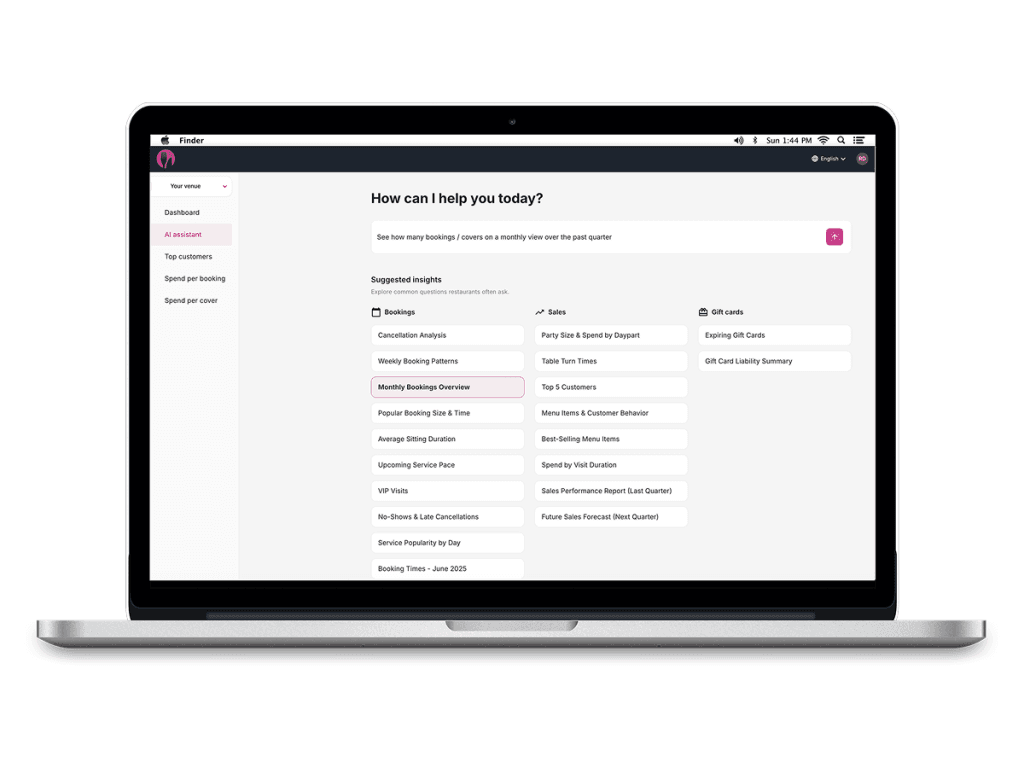
Now Book It pairs guest data with instant answers, automated end-of-day reporting, and AI-powered recommendations built for the operator, not just the diner — so you get a plain answer to “how did tonight go and what should I change,” not just a system of record. CRM runs on top of the same guest database: automated marketing email and SMS campaigns that re-engage guests using their actual visit history, allergies, and preferences.
OpenTable’s AI insights works on the diner-facing side of the business — personalised recommendations in its consumer app. Where OpenTable does help operators is guest relationship tools and automated email marketing campaign, only on the Pro plan.
AI phone receptionist
OpenTable doesn’t offer a native AI voice receptionist. Restaurants that want AI call handling alongside OpenTable have to bolt on a separate third-party tool. These are options on the market integrate with OpenTable’s system but come as their own subscription, their own setup, and their own support relationship.
Now Book It features Sadie, a 24/7 voice AI receptionist, as part of the platform. She answers every call, logs reservations, and handles enquiries around the clock, so your team isn’t relying on a second vendor to close the gap for phone bookings. Every call she handles is already syncing straight into the same guest record and diary you’re already using. It also means you’re not adding two different platforms to your already busy tech stack.
Gift cards & events management
Gift cards are built into the Now Book It system at virtually no extra cost, and events and functions can be sold and managed as a natural extension of your regular diary — useful for wineries, function-heavy venues, and anyone diversifying beyond the standard table booking.
OpenTable’s flagship product here is Experiences — bookable, customisable events like tasting menus, chef’s tables, and cooking classes, available on only on their Core and Pro plans.
24/7 support options
OpenTable backs its plans with 24/7 support but operates as a large, centralised, multi-language call centre model built to serve tens of thousands of restaurants worldwide.
Now Book It’s support is also 24/7 — but 100% local. Restaurants speak to a hospitality-trained team through dedicated phone lines for Australia, New Zealand, the United States, and Canada, not a generalised, global queue.
Now Book It vs Opentable: The verdict
Pick Now Book It if you want a flat, predictable monthly cost, full ownership of your guest data from the first booking, a truly white-labelled widget, a native AI receptionist, AI reporting capabilities and a local support team that’s actually reachable at 2am on a Saturday.
Pick OpenTable if new-diner discovery is your top priority and you’re comfortable with a marketplace model — variable per-cover fees, shared guest data with permission, and OpenTable positioned as the primary system managing your bookings.
Frequently asked questions
Is Now Book It cheaper than OpenTable?
Now Book It charges one flat monthly fee with no commission and no per-cover charges. OpenTable adds a $1–$1.50 per-cover network fee and a 2% service fee on top of its $149–$499 monthly plans, so its total cost rises with your booking volume in a way Now Book It’s doesn’t.
Does OpenTable have an AI phone receptionist?
Not natively. OpenTable is reservation and table management software; restaurants that want AI to answer their phone need to add a separate third-party tool. Now Book It includes Sadie, a native 24/7 AI receptionist, as part of the platform.
Who owns guest data — OpenTable or Now Book It?
On OpenTable, data you enter directly belongs to you, but guests who book through OpenTable’s marketplace are OpenTable’s users first, shared back only with permission. On Now Book It, every guest’s data belongs to the venue from the first booking, with no marketplace layer involved.